
NewsDetails
Processing Technology and Quality Inspection of Heat Exchanger Tube Sheets
author:Kairuifeng time:2026-09-29 22:11:07 Click:192
I. Overview of Tube Sheets
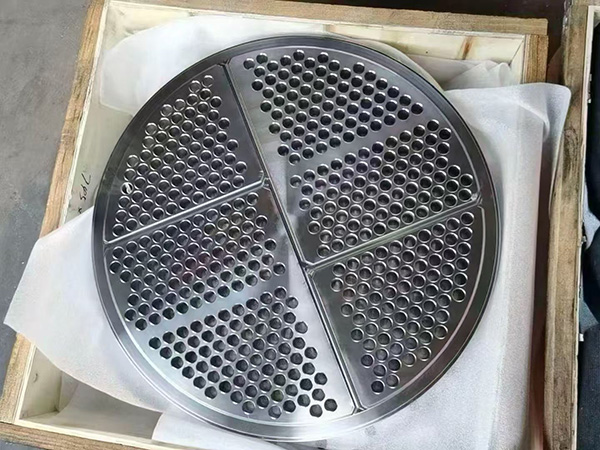
The tube sheet is a core component in shell-and-tube heat exchangers, condensers, evaporators, and other equipment, used to secure the heat transfer tubes and separate the tube-side and shell-side media. A large number of tube holes, arranged in a specific pattern, are drilled into the tube sheet. The heat transfer tubes pass through these holes and are connected to the tube sheet by expansion or welding. The machining accuracy of the tube sheet directly affects the sealing performance and service life of the heat exchanger.
II. Classification of Tube Sheets
1. Classification by material: carbon steel tube sheets, stainless steel tube sheets, clad steel tube sheets (carbon steel base layer + stainless steel cladding layer), copper alloy tube sheets, titanium alloy tube sheets, etc.
2. Classification by structure: Fixed tubesheet, floating tubesheet, U-tube tubesheet, etc.
3. Classification by application: heat exchanger tube sheets, condenser tube sheets, evaporator tube sheets, waste heat boiler tube sheets, etc.
III. Processing Technology
1. Cutting: Cut the steel plate according to the dimensions specified in the drawings, leaving a machining allowance.
2. Turning: Turn both sides of the tube sheet, the outer diameter, and the stepped surfaces to ensure flatness and thickness tolerances.
3. Drilling: Drill according to the hole layout diagram. A radial drill, CNC drilling machine, or multi-axis drilling machine may be used. High drilling accuracy is required, with hole position deviation generally not exceeding ±0.5 mm.
4. Reaming/Countersinking: Ream or countersink the tube holes to ensure dimensional accuracy of the hole diameter and surface roughness.
5. Grooving: Machine expansion grooves on the inner wall of the tube hole to enhance the sealing performance of the expansion joint.
6. Tube Plate Surfacing: Composite tube plates or tube plates requiring corrosion resistance must be surfaced with stainless steel or corrosion-resistant alloys on the sealing surfaces.
IV. Quality Inspection
1. Dimensional Inspection: Inspects the thickness, diameter, flatness, tube hole diameter, hole spacing, and hole position deviation of the tube sheet.
2. Surface Quality Inspection: Inspect the inner wall of the tube hole for defects such as cracks, scratches, and burrs.
3. Non-destructive testing: Ultrasonic testing shall be performed on the base layer of the tube sheet, and penetrant testing or ultrasonic testing shall be performed on the overlay layer.
4. Chemical Composition Analysis: Perform spectral analysis on the material to confirm that the chemical composition meets the requirements.
5. Hardness Testing: Test the hardness of the tube sheet to ensure the performance of the expansion joint.
V. Execution Standards
GB/T 151 "Heat Exchangers", NB/T 47002 "Composite Plates for Pressure Vessels", GB/T 14976 "Seamless Stainless Steel Tubes for Fluid Transport", TEMA "Tubular Exchanger Manufacturers Association Standards", ASME BPVC Section VIII, etc.
VI. Common Materials
Base layer: Q245R, Q345R, 20#, 16Mn; Overlay layer: 304, 304L, 316, 316L, titanium, copper, etc.
Cangzhou Kairuifeng Pipeline Equipment Co., Ltd. specializes in the production of various types of heat exchanger tube sheets, offering high-precision processing and customization for large diameters. Inquiries and purchases are welcome.
 Contact us
—— Contact:Manager
—— Tel:+86 15720204999
—— Email:zeleiliu97@gmail.com
—— Url:https://www.krfpipe.com
—— Address:No. 108 Longhai West Road, Yanshan Town, Yanshan County