
NewsDetails
What are the differences between elliptical heads and dished heads? How should they be selected?
author:Kairuifeng time:2026-09-29 22:19:13 Click:58
Question: What is the difference between an elliptical head and a dished head? How to select them?
Heads are an important component of pressure vessels, storage tanks, reactors, and other equipment. Elliptical heads and dished heads are the two most commonly used forms.
I. Differences in Structure and Shape
1. Elliptical Head: The curved portion is a half-ellipsoid, and the standard elliptical head has a major-to-minor axis ratio of 2:1. The curved transition is smooth, with the curvature changing continuously from the top to the straight edge section, resulting in a full profile. It consists of an elliptical curved section and a straight edge section.
2. Dished Head: It consists of three parts: a spherical top section, a transition arc section (knuckle), and a straight flange section. The top is relatively flat, with a noticeable change in curvature at the transition arc, making its profile shallower and flatter than that of an elliptical head. The radius of the spherical section is generally 0.7 to 1.0 times the head diameter, and the radius of the transition arc is generally 0.06 to 0.15 times the head diameter.
II. Differences in Load-Bearing Performance
Elliptical Head: The stress distribution is relatively uniform, with the maximum stress occurring at the top and edges, resulting in a lower degree of stress concentration. Under the same conditions of diameter, thickness, and material, it has a higher pressure-bearing capacity than a dished head.
Dished Head: There is significant stress concentration at the junction between the spherical segment and the transition arc segment, where the abrupt change in curvature generates substantial bending stress. The smaller the radius of the transition arc, the more severe the stress concentration becomes. Under identical conditions, its pressure-bearing capacity is lower than that of an elliptical head, requiring a greater wall thickness.
III. Differences in Manufacturing Processes
Elliptical Heads: The complex curved surface requires dedicated elliptical dies for stamping, resulting in high die costs. Large-diameter heads are typically formed by spinning, which eliminates the need for large dies but demands high process precision.
Dished Head: The top is spherical, with a fixed transition arc radius. The stamping die is relatively simple, making it easy to manufacture and less costly than an elliptical head.
IV. In-depth Differences
The depth of an elliptical head is relatively deep: the depth of a standard elliptical head is approximately 1/4 of the head diameter. The depth of a dished head is relatively shallow: approximately 1/5 to 1/6 of the head diameter, which is shallower than that of an elliptical head.
V. Comparison of Applicable Scenarios
Applicable to elliptical heads: Medium- and high-pressure pressure vessels; equipment with high load-bearing requirements and uniform stress distribution; reactors, heat exchangers, and storage tanks in the petrochemical, power, and pharmaceutical industries; equipment subjected to alternating loads and fatigue loads; pressure vessels with a design pressure of 1.0 MPa or higher (recommended).
Applicable to dished heads: Low-pressure and atmospheric-pressure vessels; storage tanks with low stress requirements and primarily used for storage; situations with limited installation space and shallow head requirements; cost-sensitive projects with limited budgets; atmospheric and low-pressure vessels with a design pressure not exceeding 1.0 MPa.
VI. Selection Principles
1. Selection by pressure rating: Elliptical heads must be used for PN ratings of 1.6 MPa or higher; elliptical heads are preferred for ratings between 0.6 and 1.6 MPa; dished heads may be used for ratings below 0.6 MPa.
2. Selection based on medium characteristics: For toxic, flammable/explosive, or highly corrosive media, elliptical heads are preferred; for general media, selection can be made based on pressure.
3. Select based on installation space: Use an elliptical head if space is sufficient; consider a dished head if space is limited, provided that strength requirements are met.
4. Selection based on economy: Under the premise of meeting strength and safety requirements, dished heads can be selected for low-pressure containers to reduce costs; however, elliptical heads must be selected for medium- and high-pressure containers.
7. Precautions
1. Arbitrary substitution is not permitted: Elliptical heads specified in the design drawings shall not be changed to dished heads without authorization;
2. Verification of dished heads: Strength calculations must be performed in accordance with the standard; they cannot be simply selected based on the thickness of elliptical heads;
3. The transition arc radius should not be too small: The transition arc radius of a standard dished head is generally not less than 10% of the head diameter;
4. The height of the straight edge section shall meet the standard requirements;
5. Non-destructive testing shall be performed after the forming of medium- and high-pressure heads, with particular emphasis on the transition zone of dished heads.
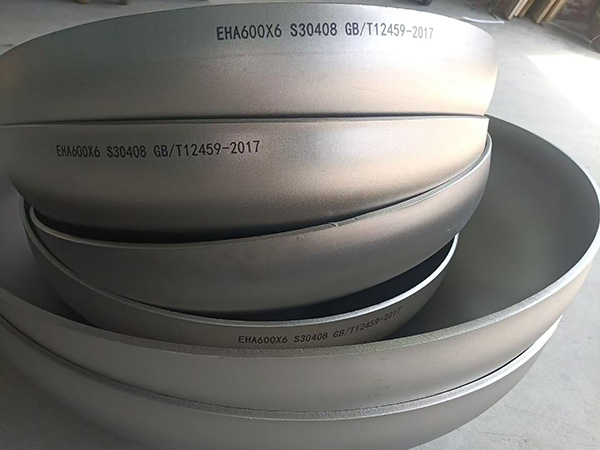
Cangzhou Kairuifeng Pipeline Equipment Co., Ltd. specializes in the production of various types of heads, including elliptical, dished, spherical, and conical heads. We offer a complete range of specifications and support customization for large diameters. Inquiries and purchases are welcome.
 Contact us
—— Contact:Manager
—— Tel:+86 15720204999
—— Email:zeleiliu97@gmail.com
—— Url:https://www.krfpipe.com
—— Address:No. 108 Longhai West Road, Yanshan Town, Yanshan County