
NewsDetails
What is the pressure rating PN of a flange? How is it determined?
author:Kairuifeng time:2026-09-29 22:17:51 Click:84
Question: What is the pressure rating PN of a flange? How is it determined?
The pressure rating (PN) of a flange is a critical parameter in flange selection, directly affecting the safe operation of the piping system.
I. What is the PN Pressure Rating
PN (Pressure Nominal) is the pressure class designation for flanges and piping components, indicating the maximum working pressure a flange can withstand at a specified temperature. The PN value is a standardized nominal value, not the actual working pressure, but rather a classification used for standardizing flange dimensions and ensuring interchangeability. The unit of the PN class is bar (1 bar = 0.1 MPa); for example, PN16 indicates a nominal pressure of 16 bar (1.6 MPa).
II. Common PN Grade Series
European System (HG/T 20592, DIN, GB): PN2.5, PN6, PN10, PN16, PN25, PN40, PN63, PN100, PN160.
ANSI/ASME B16.5 (Class Ratings): Class 150, Class 300, Class 400, Class 600, Class 900, Class 1500, Class 2500.
Note: European system PN and American system Class cannot be simply equated. They have different temperature-pressure ratings, and their flange dimensions are not interchangeable. They must not be mixed.
III. The Effect of Temperature on Pressure Ratings
The maximum allowable working pressure of flanges decreases as the temperature rises. Carbon steel flanges can withstand the nominal pressure at room temperature, but the allowable pressure gradually decreases as the temperature increases. Stainless steel flanges have better high-temperature performance than carbon steel, but their allowable pressure also decreases significantly above 400°C. Alloy steel flanges (15CrMo, 12Cr1MoV) exhibit good high-temperature performance. When selecting flanges, the operating temperature must be taken into account; one should not rely solely on the PN value.
IV. How to Determine the PN Rating of a Flange
Method 1: Determined Based on Pipeline Design Pressure (Most Common)
1. Determine the pipeline design pressure P (MPa); 2. Convert to bar: P_bar = P × 10; 3. Select the closest standard PN rating that is greater than or equal to P_bar; 4. Consider temperature correction and appropriately increase the PN rating for high-temperature conditions.
Example: Design pressure 1.2 MPa, operating temperature 250°C, carbon steel flange. 1.2 MPa = 12 bar, select PN16. After considering the temperature correction for 250°C, the allowable pressure for PN16 carbon steel is approximately 1.3 MPa, which meets the requirements.
Method 2: Determination Based on Pipe Wall Thickness Schedule: There is a correspondence between the pipe wall thickness schedule (Sch) and the flange PN rating. The corresponding PN rating can be selected based on the pipe wall thickness.
Method 3: Determined by the equipment flange interface: The flange connected to the equipment shall have a PN rating consistent with the equipment interface flange.
V. Selection Considerations
1. Pairing consistency: The two flanges to be connected must have the same PN rating, the same sealing surface type, and the same standard system;
2. Allow for a margin: The PN rating selection should include an appropriate margin, generally not less than 1.25 times the design pressure;
3. Consider temperature: For high-temperature operating conditions, the allowable working pressure must be determined by consulting the temperature-pressure chart;
4. Bolt matching: Flanges of different PN ratings have different numbers of bolts, bolt diameters, and bolt hole distributions;
5. Gasket matching: Gasket dimensions vary depending on the PN rating;
6. Valve matching: The PN rating of the flange connected to the valve shall be consistent with the nominal pressure of the valve.
VI. Frequently Asked Questions
Q: Are PN10 and PN16 flanges interchangeable? A: No. The number of bolt holes, bolt diameter, and sealing surface dimensions may differ.
Q: What is the equivalent PN rating for Class 150? A: There is no simple one-to-one correspondence. At ambient temperature, Class 150 carbon steel is approximately equivalent to PN20, but the two should not be used interchangeably.
Q: Can high PN flanges be used for low-pressure pipelines? A: Yes, but it is not economical.
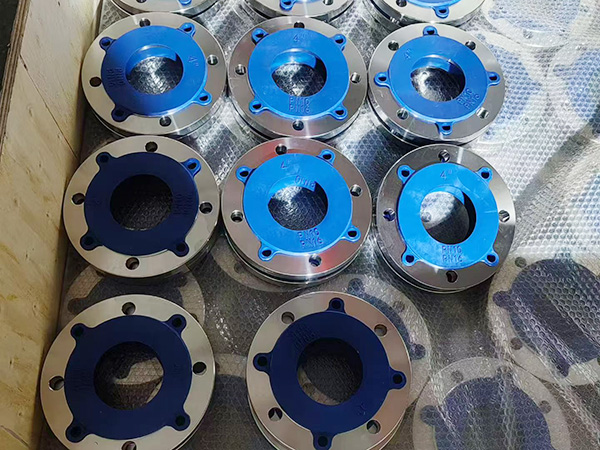
Cangzhou Kairuifeng Pipeline Equipment Co., Ltd. specializes in the production of flange products with various PN grades and materials, offering a complete range of specifications. We welcome your inquiries and purchases.
 Contact us
—— Contact:Manager
—— Tel:+86 15720204999
—— Email:zeleiliu97@gmail.com
—— Url:https://www.krfpipe.com
—— Address:No. 108 Longhai West Road, Yanshan Town, Yanshan County